-
September 21, 2026
-
10 Views
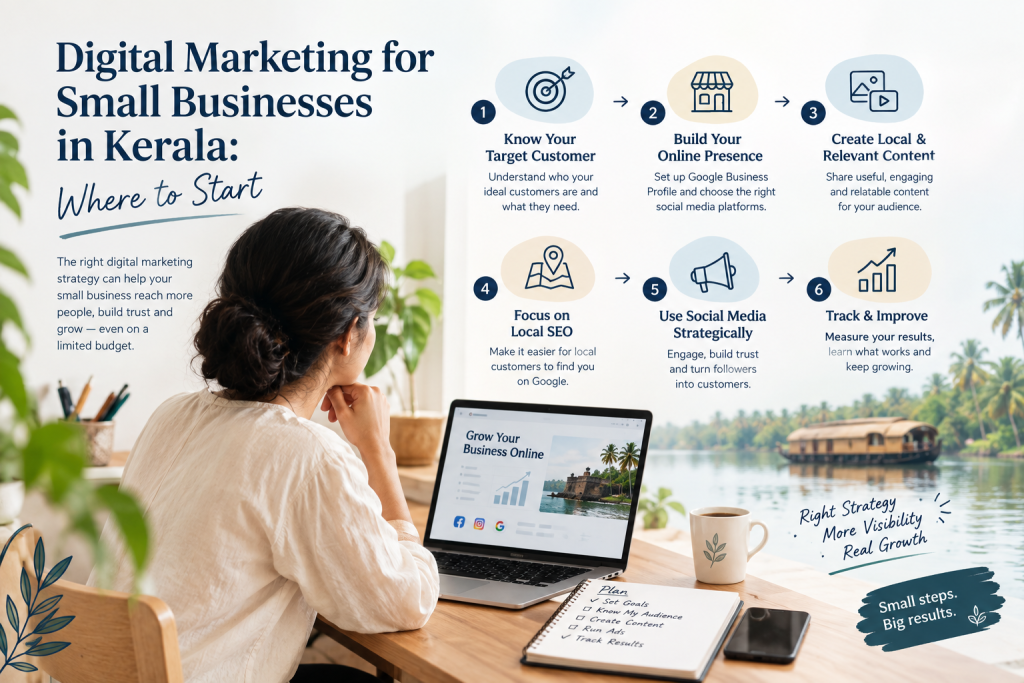
Digital Marketing for Small Businesses in Kerala: Where to Start
Running a small business in Kerala today is not only about having a good product or service. Customers increasingly discover businesses online, compare options, check reviews, visit social media pages, and search on Google before making a decision.
For small businesses, this creates a valuable opportunity. You don’t necessarily need a huge marketing budget to build an online presence. What you need is the right strategy, consistent communication, and a clear understanding of your target customers.
Kerala has a growing entrepreneurial and MSME ecosystem. The Kerala Directorate of Industries and Commerce reported that more than 2.43 lakh MSMEs had been established in the state by March 2024 through the state’s enterprise initiatives.
So, if you are a small business owner in Kerala wondering “Where should I start with digital marketing?”, this guide will help you understand the essential steps.
Why Digital Marketing Matters for Small Businesses in Kerala
Traditional marketing such as newspapers, banners, brochures, and word-of-mouth can still have value. However, digital marketing allows a small business to reach people where they already spend a significant amount of their time — online.
Customers may search for:
Restaurants near them
Clothing and jewellery stores
Beauty and wellness services
Digital services
Home businesses
Local shops
Educational services
Travel and tourism businesses
Professional services
A strong online presence can help potential customers discover your business, understand what you offer, and contact you.
Research focusing on SMEs in Kerala has also identified factors such as marketing performance, cost efficiency, digital readiness, and managerial support as important in the adoption of social media marketing.
The key point is simple: digital marketing should be treated as a business strategy, not just posting on Instagram.
Step 1: Understand Your Target Customer
Before creating social media accounts or running advertisements, identify who you want to reach.
Ask yourself:
Who is my ideal customer?
Where are they located?
What problem are they trying to solve?
What age group do they belong to?
What type of content do they consume?
What makes them choose one business over another?
Do they prefer Malayalam, English, or a combination of both?
For example, a local boutique in Pattambi may have a completely different audience from a Kochi-based software company.
Your marketing becomes more effective when your message is created specifically for your audience.
Step 2: Build a Professional Online Presence
Your online presence is often the first impression customers get of your business.
Start with the basics:
Google Business Profile
For businesses serving a specific location, appearing in Google Search and Google Maps can be extremely useful. Keep your business name, address, phone number, opening hours, website, photos, services, and other information updated.
Social Media Profiles
Choose platforms that are relevant to your customers instead of trying to be everywhere.
Depending on your business, this could include:
Instagram
Facebook
YouTube
WhatsApp Business
LinkedIn
Other relevant platforms
Make sure your profile clearly communicates:
What you do + Who you help + Where you operate + How customers can contact you.
Step 3: Create Local and Relevant Content
Content is one of the most important parts of digital marketing.
For a Kerala-based business, your content can be made more relatable by understanding local customer behaviour, language, culture, and interests.
You can create:
Educational posts
Product demonstrations
Customer testimonials
Frequently asked questions
Behind-the-scenes content
Short-form videos
Before-and-after content
Offers and announcements
Customer stories
Tips related to your industry
For a local audience, Malayalam or bilingual content can also be considered when it matches your target customers.
The goal is not simply to post every day. The goal is to create content that gives people a reason to notice, trust, and remember your business.
Step 4: Focus on Local SEO
If your business depends on customers from a particular location, local SEO should be part of your strategy.
For example, instead of only targeting a broad keyword such as:
“Digital marketing services”
you may target more specific searches such as:
“Digital marketing freelancer in Pattambi”
or
“Digital marketing services in Kerala”
Local SEO can involve:
Google Business Profile optimization
Location-specific website pages
Relevant local keywords
Customer reviews
Consistent business information
Useful local content
Website SEO
This helps search engines understand where your business operates and what services you provide.
Step 5: Use Social Media Strategically
Many small businesses create social media pages but struggle to turn followers into customers.
The solution is not necessarily to post more. Instead, create a clear content strategy.
For example, you can divide your content into four categories:
Educate – Teach customers something useful.
Engage – Ask questions, conduct polls, and encourage interaction.
Build Trust – Share testimonials, results, behind-the-scenes content, and expertise.
Convert – Promote your products, services, offers, and calls to action.
This creates a more balanced social media presence instead of making every post a sales advertisement.
Step 6: Consider Paid Advertising
Organic marketing can take time. Paid advertising can help businesses reach specific audiences more quickly.
Platforms such as Meta Ads and Google Ads allow businesses to target audiences based on factors such as location, interests, search intent, and other available targeting signals.
However, don’t start advertising without a plan.
Before launching an advertisement, determine:
Your campaign objective
Your target audience
Your offer
Your advertising budget
Your landing page or destination
Your call-to-action
How you will measure results
For example, your objective could be:
More WhatsApp enquiries → More qualified leads → More customers
Instead of simply measuring how many people saw your advertisement, focus on meaningful business outcomes.
Step 7: Create a Mobile-Friendly Website
Your website acts as your digital home.
A professional website can help customers:
Understand your services
Learn about your business
View your work
Read testimonials
Contact you
Find your location
Take the next step toward becoming a customer
Since many customers access websites through smartphones, make sure your website is fast, responsive, easy to navigate, and simple to use.
Your website should also have clear calls to action such as:
Call Now | WhatsApp Us | Get a Quote | Book a Consultation
Step 8: Build Trust Through Reviews and Testimonials
Trust is extremely important for small businesses.
A potential customer may hesitate to purchase from a business they don’t know. Reviews and testimonials can help reduce that uncertainty.
Encourage satisfied customers to share genuine feedback.
You can showcase testimonials on:
Google
Your website
Instagram
Facebook
Other relevant platforms
Never create fake reviews. Authentic customer experiences are much more valuable for building long-term credibility.
Step 9: Track Your Results
One of the biggest advantages of digital marketing is the ability to measure performance.
Depending on your business, track metrics such as:
Website visitors
Phone calls
WhatsApp enquiries
Leads
Social media engagement
Ad clicks
Conversion rate
Cost per lead
Sales
Don’t become obsessed with follower counts alone.
A page with fewer followers can still generate valuable business if the audience is relevant and the customer journey is well designed.
Step 10: Start Small and Improve Consistently
One common mistake small businesses make is trying to do everything at once.
You don’t need to immediately invest in SEO, Instagram, YouTube, Google Ads, Meta Ads, blogging, email marketing, and every other channel.
Start with the platforms and strategies that are most relevant to your business.
A simple starting plan could be:
Month 1
Set up your website, Google Business Profile, social media profiles, and basic branding.
Month 2
Develop a consistent content strategy and start publishing useful content.
Month 3
Analyze what is working and consider introducing SEO or paid advertising.
Then continue testing, measuring, and improving.
Common Digital Marketing Mistakes Small Businesses Should Avoid
1. Posting Without a Strategy
Random posts may not communicate a clear message about your business.
2. Trying to Be Everywhere
Choose platforms based on your audience rather than following every trend.
3. Focusing Only on Followers
Followers are not the same as customers.
4. Ignoring Local SEO
If your business serves a local market, make sure people can find you when searching for relevant services nearby.
5. Expecting Instant Results
Digital marketing generally requires testing and consistency. A campaign may need optimization before you know what works for your audience.
6. Spending on Ads Without Tracking
Running advertisements without measuring leads, enquiries, or conversions can make it difficult to understand whether your investment is producing useful results.
How Haneena Digital Can Help
Every business has different goals, customers, and challenges. That’s why digital marketing should not be based on a one-size-fits-all approach.
At Haneena Digital, I focus on helping businesses build a stronger online presence through practical and result-oriented digital marketing strategies.
My services include:
Search Engine Optimization (SEO)
Social Media Marketing
Content Marketing
Meta Ads Management
Google Ads
Website Development
Branding & Personal Branding
AI-Powered Marketing
Whether you’re starting from zero or looking to improve an existing online presence, the first step is understanding your business, your audience, and your goals.
You can learn more about my services and digital marketing work on my website:
Haneena Digital — https://haneenadigital.com/
Final Thoughts
Digital marketing doesn’t have to be complicated for a small business in Kerala.
Start with the fundamentals:
Know your audience → Build your online presence → Create useful content → Improve local visibility → Use advertising strategically → Measure your results → Keep improving.
The goal isn’t to be present on every platform. The goal is to be visible in the right places, communicate the right message, and make it easy for the right customers to choose your business.
For small businesses, a well-planned digital presence can become an important part of building visibility, credibility, and long-term growth.
If you’re ready to take your business online, start with a strategy — not just a social media post.
Explore Haneena Digital to learn more about digital marketing services and how I can help your business build a stronger online presence.
Top Category
- Design (1)
- Digital Marketing (1)
- Marketing Tips (1)
- Social Media Marketing (1)
Leave a comment